(313) 327-2262 (text only)


Creating Your Altar & Sacred Space
As an Amazon Associate, I earn from qualifying purchases.
An altar is much more than a table covered with candles and crystals. It is a place where you intentionally step away from the distractions of everyday life and into sacred space. Whether you're lighting a candle for meditation, reading tarot cards, practicing spellwork, or simply spending a few quiet moments in reflection, your altar becomes the focal point of your energy, intentions, and spiritual practice.
One of the wonderful things about creating an altar is that there is no single "correct" way to do it. Every tradition, every practitioner, and every path has its own customs and preferences. Some witches prefer carefully structured altars that correspond to the four elements and cardinal directions, while others create something much more intuitive and personal. Your altar should reflect your own practice rather than someone else's idea of what it should look like.
As your practice grows, your altar will naturally grow with it. You may add new tools, remove items that no longer resonate with you, or decorate it to reflect the changing seasons or Sabbats. Over time, it becomes more than a collection of objects; it becomes a reflection of your own spiritual journey.
Choosing a Sacred Space
Your altar doesn't need to occupy an entire room. It can be as simple as a small table, a bookshelf, a windowsill, or even a corner of your desk. If space is limited, many witches create portable altars using a decorative box or small container that can be stored away when not in use.
Choose a location where you feel comfortable and where you're less likely to be interrupted. Before setting up your altar, I recommend cleaning the area both physically and energetically. A clean space helps create a clear mind, and taking a few moments to cleanse the area with incense, sound, visualization, or prayer can help you mentally transition into your spiritual practice.
And if you’re in the broom closet (not letting people know that you’re a practicing witch), don’t fret. Back when I was in the broom closet, I used to store my altar supplies in an old fashioned suitcase. I would take it with me to parks where I could be alone to practice my faith. You can do something similar.
What Belongs on an Altar?
One of the first questions beginners ask is, "What should I put on my altar?"
The simple answer is: anything that supports your practice and has meaning to you.
Some of the most common altar items include candles, crystals, herbs, incense, a chalice or bowl of water, a dish of salt, a pentacle, a cauldron, a wand, an athame, tarot or oracle cards, and your Book of Shadows. Some witches also include statues of deities, photographs of loved ones or ancestors, feathers, seashells, flowers, or meaningful objects collected from nature.
Before placing something on your altar, take a moment to ask yourself why you're drawn to it. Learn about its symbolism and consider how it supports your practice. An altar becomes far more meaningful when each item has a purpose rather than simply filling empty space.
A Simple Beginner's Altar
If you're just getting started, resist the temptation to fill your altar with every tool you can find. A simple altar is often the best place to begin.
I recommend starting with:
-
A white candle
-
A small bowl of water
-
A dish of salt
-
Your Book of Shadows or journal
-
One item (or more) that has personal meaning to you
That's more than enough to begin building a meaningful practice. As your interests grow, your altar can grow alongside them.
Looking for some recommendations?
Be sure to check out my Altar Essentials page where I list my favorites in more detail.
Working with the Four Elements
Many witches enjoy representing the four classical elements on their altar. While every tradition approaches this a little differently, a common arrangement is:
North - Earth: Salt, stones, crystals, herbs, flowers
East - Air: Incense, feathers, bells, wand
South - Fire: Candles, charcoal, sun symbols
West - Water: Chalice, bowl of water, shells, moon symbols
These correspondences are entirely optional, but they can provide a beautiful symbolic framework for your altar and your ritual work.
Altar Layout Examples
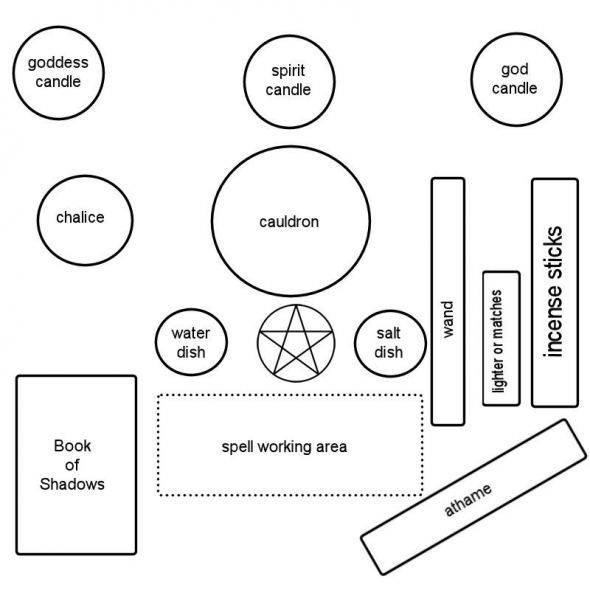
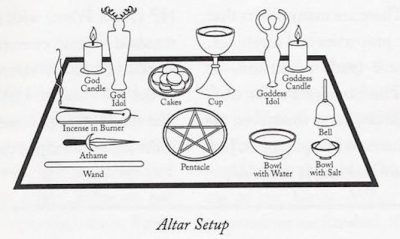
The diagrams below shows two examples of how an altar might be arranged. Notice that the working area remains open, candles are placed toward the back for safety, and commonly used tools are kept within easy reach.
Remember that these are simply examples. Your altar should be arranged in a way that feels practical, comfortable, and meaningful for the way you work.
Let Your Altar Grow With You
One of my favorite things about having an altar is that it is always changing. Mine changes throughout the year as the seasons change, my interests evolve, and my practice continues to grow.
Some of my favorite altar pieces didn't come from a metaphysical shop at all. Many were collected during walks on the beach or hikes through the forest: seashells, pinecones, feathers, interesting stones, and other little reminders of meaningful moments. Those personal treasures often mean far more to me than something purchased simply because it looked "witchy."
Allow your altar to evolve naturally over time. It should tell the story of your journey, reflect what inspires you, and serve as a place where you can pause, reconnect, and continue growing in your practice.
THE START HERE GUIDE SECTIONS
-
Essential Tools (Learning the Tools of Witchcraft)
-
Creating Your Altar (Building Your Sacred Space)
-
Magickal Correspondences (Herbs, Crystals, Incense & More)
-
Moon Magick (Working with the Lunar Cycle)
-
Divination (Tarot, Oracle Cards, Pendulums & More)
-
Spellcraft (Step-by-Step Spellcasting)
-
Developing Intuition for Witchcraft (Psychic Development)


